
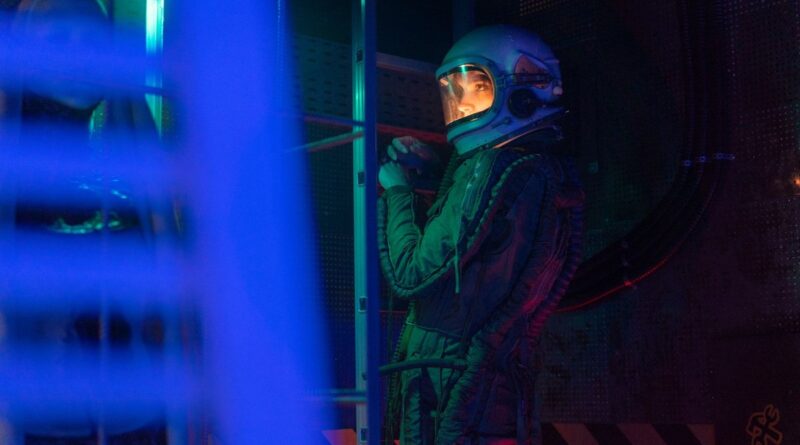
Bezos’ 2045 Space Living Prophecy: On Track or Orbital Dream?

Hostinger Cloud Hosting: Ultra-Fast NVMe Storage & 99.9% Uptime Guarantee
Power your high-traffic WordPress websites with managed cloud infrastructure, automated daily backups, free SSL, and 24/7 expert support.
📌 Key Takeaways
- Jeff Bezos predicted millions of people could inhabit space by 2045, with robots undertaking essential labor.
- The vision, reported by NDTV, emphasizes space industrialization and human expansion beyond Earth.
- As of 2026, significant technological hurdles remain, particularly in scaling orbital habitats and perfecting closed-loop life support systems.
- The prediction drives innovation in aerospace, AI, and robotics, shaping long-term goals for human presence in space.
Bezos’ 2045 Space Living Prophecy: On Track or Orbital Dream?
In a bold prediction that continues to resonate through the burgeoning space industry, Amazon founder Jeff Bezos once projected that millions of humans could be living and working in space by 2045, with advanced robotics handling the bulk of the manual labor. This ambitious vision, as reported by NDTV, set a benchmark for future space colonization efforts, prompting ongoing debate and innovation.
The prediction, made in the years prior to 2026, outlined a future where humanity’s footprint extends beyond Earth’s biosphere, establishing self-sustaining communities in orbital settlements. Bezos, through his aerospace company Blue Origin, has consistently advocated for space industrialization and the eventual off-world migration of heavy industry, freeing Earth for residential and light-industry purposes. His 2045 timeline positioned this future as a near-term possibility, fueled by advancements in propulsion, life support systems, and artificial intelligence.
Key Analysis: The Path to Orbital Habitation
As of October 2026, the feasibility of Bezos’s 2045 target remains a subject of intense scrutiny within the scientific and engineering communities. While significant strides have been made in reusable rocket technology, notably by SpaceX and Blue Origin, the scale of infrastructure required to house millions off-world presents monumental challenges. Current orbital habitats, such as the International Space Station (ISS) successors being developed by commercial entities like Axiom Space and Orbital Reef (a consortium including Blue Origin), are designed for dozens, not millions.
Experts at NASA’s Advanced Exploration Systems division and the European Space Agency (ESA) acknowledge the long-term goal of space colonization but often cite the immense hurdles in radiation shielding, closed-loop life support systems, and psychological adaptation to prolonged space dwelling. Research from institutions like MIT’s Space Systems Laboratory continues to explore modular habitat designs and artificial gravity concepts, yet scaling these to support populations in the millions by 2045 would necessitate an unprecedented acceleration of technological development and global investment. The role of robotics, as envisioned by Bezos, is indeed advancing rapidly, with AI-powered autonomous systems showing promise in construction, maintenance, and resource extraction in extraterrestrial environments, as demonstrated by early lunar rover missions and Mars Perseverance operations.
Societal and Economic Implications
Should such a future materialize, the societal implications would be profound. The concept of space citizenship, governance structures for orbital communities, and equitable access to off-world resources would become critical ethical and legal debates. Economically, the establishment of space colonies would ignite new trillion-dollar industries, from space tourism and resource mining to orbital manufacturing and energy generation. This vision aligns with broader trends of humanity seeking new frontiers for growth and resource diversification, driven by increasing planetary pressures.
Why This Matters in the Long Run
Bezos’s 2045 prediction, while ambitious, serves as a powerful catalyst for innovation, pushing the boundaries of what is considered possible in space exploration and human expansion. It frames the long-term trajectory of the space industry beyond mere scientific discovery or national prestige, positioning it as a critical pathway for humanity’s future resilience and prosperity. The pursuit of such goals drives fundamental research in materials science, AI, biology, and energy, with terrestrial spin-offs that benefit life on Earth. The timeline itself acts as a strategic pressure point, urging continuous investment and collaborative efforts across public and private sectors to overcome the formidable engineering and human challenges of becoming a multi-planetary species.
As 2045 approaches, the world watches to see if this audacious vision will transition from a technological aspiration to a tangible reality, reshaping the very definition of human civilization.
📌 Key Questions Answered
What was Jeff Bezos's prediction regarding space habitation?
Jeff Bezos predicted that millions of people could be living in space by the year 2045, with robots performing the necessary labor to support these communities.
Which company is associated with Jeff Bezos's space ambitions?
Jeff Bezos founded Blue Origin, an aerospace company focused on expanding human presence in space, which aligns with his vision for future space living.
What is the primary role envisioned for robots in this future space scenario?
Robots are envisioned to handle the bulk of the manual labor in space, including construction, maintenance, and resource extraction, allowing humans to focus on other aspects of life and work.
📚 Story Sources:
- Jeff Bezos Predicts Millions Could Live In Space By 2045, Robots To Do The Work – NDTV (news.google.com)
This article was synthesized by AI from the multiple sources above for educational and informational purposes.
Image Credit: Photo by Mikhail Nilov on Pexels